

Kakwa research study from 1984:
First Nations
The Beaver and Carrier First Nations were the first people to use Kakwa, followed in the eighteenth century by the Cree, Iroquois and Metis, who began to enter the area during the western expansion of the fur trade. Early European explorers mentioned Indian trails crossing the Kakwa area. Those trails may have been used for trade between the Aboriginals of the Peace River area in Alberta and those in the Fort George area in British Columbia.
First Europeans
The first European explorer in the Kakwa area was Alexander MacKenzie, who in 1793 became the first European person to cross the North American continent. He crossed the Continental Divide about 50 miles west of Mount Sir Alexander, the mountain that bears his name. Almost a century later, in 1875, E.W. Jarvis, surveyor for the Canadian Pacific Railway, made a reconnaissance survey over the Continental Divide in the Kakwa area (Fleming, 1877). His party travelled in winter from Fort George through Jarvis Creek Valley and Jarvis Lakes to Fort Edmonton. His party was to investigate a pass from the headwaters of the Fraser River to those of the Smoky River.
Early Explorers
In 1907, a young Englishman named Spencer H. Tuck was engaged by a lumber company to make a reconnaissance of the Rocky Mountains northward from the Yellowhead pass and went through the Wapiti Pass located north of Kakwa. It is likely that Tuck also explored the Jarvis Pass and the McGregor Pass areas in Kakwa Park and probably also the Monkman Pass area (Bowes, 1963).
Later, interest in the area between Mount Robson and Kakwa came from trappers and hunters. In 1928, a committee on Game Reserves and Trails appointed by the McBride District Board of Trade suggested that a proposed game reserve in the Sheep Pass area, south of Kakwa, should be abandoned and also the trail to Sheep Pass should be improved to open the only sheep hunting country in B.C. within reasonable distance of any major transportation route (Wheeler, 1979). At that time, Bill Sweeney, a trapper from McBride, was one of the early trappers at Kakwa Lake, where he was spending his winters.
Everett Monroe from McBride was a well-known outfitter who hunted and explored the Kakwa area, and according to Sheilagh Foster’s (daughter of Everett) book, Everett Monroe: The legend and the life, Everett listened to the tales of the Rocky Mountains told by Scotty Niven and Billy Sweeney. Scotty had a trapper’s cabin at Kakwa Lake, while Bill used the wreckage of a Barclay Grow aeroplane near Kakwa Lake for his rapping Shelter. In the 1960’s, Everett Monroe flew hunters into Cecilia Lake and Porcupine (Kakwa) Lake.
The Monroes of Kakwa
In the 1950’s, Everett Monroe was first drawn to the Kakwa Lake area, and his children would always look for excuses to come with him on trips into the area. While on a trip, Everett took a drink from Babette Creek and saw beautiful pink stones and took a sample home. In 1970, Everett and his daughter Sheilagh made their way into Kakwa to stake their first mineral claim, but did not have the funds to develop the quartzite. After many years of hunting and guiding in the area, Everett’s son Ian Monroe tried to have Kakwa established as a Provincial Park and in 1987, as a first step, it was officially given Recreation area status. Ian Monroe died in a helicopter accident in the Goat River valley, and the mountain above Babaette Lake was named after him: Mt Ian Monroe.
The opening of the Quartzite quarry site at Babette Lake in the late 1970s led to the construction of a tote road along the Kakwa River from Alberta. Later, another road was added to connect to the forestry road in the McGregor Valley on the B.C. side.
Although the project had a short life, the road provided motorised access to Kakwa Lake until the road was closed to motorised vehicles in 1989. Another quarry site was later developed at Wishaw Lake and is still in operation today.
The Monroe Trackway
In 2000, Everett’s son Bryan hiked into a remote region in Kakwa with a friend and found fossils and fossilised tracks. The full set of events is documented in the book written by Vivien Lougheed: Side Tracked.
Climbers
Early in the Twentieth Century, climbing parties began to arrive at Mount Sir Alexander or Kitchi as it was called at the time. The first alpinists to see the “Big Mountain” were Prof. J. Norman Collie and Mr. A.L. Mumm at the time of their ascent of Mt. Bess, north of Mount Robson, in 1911 (Collie, 1912). The year after, Mr S.P. Fay of Boston had seen the peak from the headwaters of the Peace tributaries not far from Jarvis Pass (Fay, 1915). In 1914, Mary Jobe, a teacher from New York, hired Curly Phillips to lead the first expedition to Mount Kitchi (Jobe, 1915). They attempted to climb the mountain but did not succeed. When she returned the next year, Curly Phillips and two other members of the party made it to within 30 metres of the summit. Fourteen years later, a party led by Andrew Gilmour, an American doctor, made the first successful ascent of the peak (Waffl, 1930).
Surveyors
A topographical survey party arrived in the Kakwa area in 1923-1924 to delimit the boundary between the provinces of Alberta and British Columbia (Cautley, 1925). The two_ commissioners, R.W. Cautley for the Dominion of Canada and the province of Alberta and A.O. Wheeler for the Province of British Columbia, had as a task to establish on the ground the 120th meridian from its intersection with the Continental Divide, south of Sheep Pass and the 60th parallel of latitude, which forms the north boundary of the respective provinces.
Plane crash
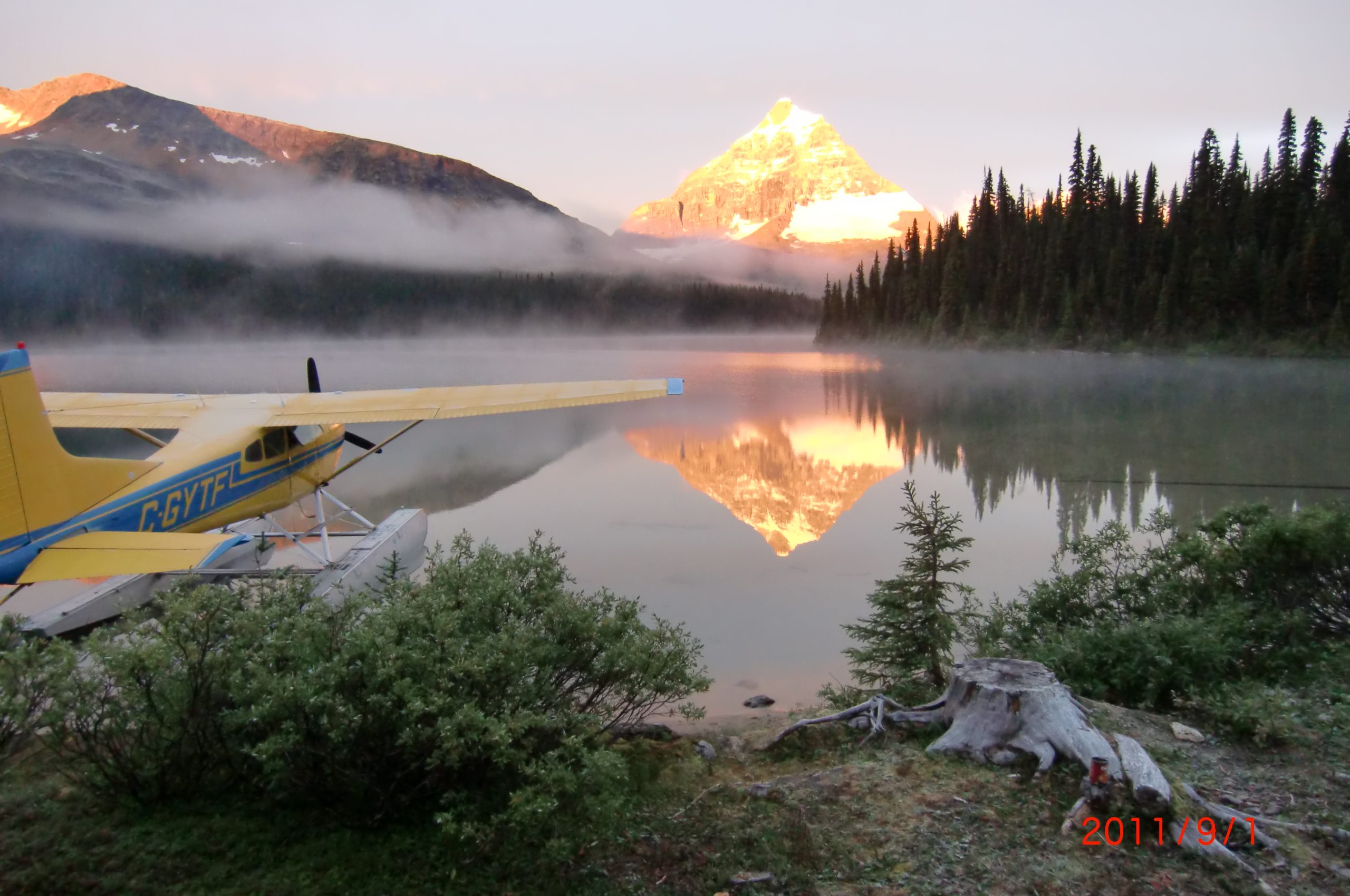
A chartered Canadian Pacific Air Barkley-Grow pontoon plane crashed in October 1945 just after take-off from Porcupine (Kakwa) Lake. The wreckage of the plane had been a major attraction for visitors until it was airlifted in 1989 and sent to the Calgary Aviation Museum, where some parts of the cockpit were used to restore the Queen of Yukon. The same type of plane was used by Admiral Byrd to charter the coastline of the Antarctic continent. In 1998, a memorial plaque was placed at the site of the crash to honour the memory of Carl Brook, who died in the accident. Carl Brook was an outfitter from Saskatoon Lake near Edmonton and was regularly bringing hunting parties to Kakwa Lake (Campbell, 1981 ).
Park Status
In 1986, Dave King of Prince George, BC (president of the Caledonia Ramblers Hiking Club) made a presentation to the Wilderness Advisory Committee in Prince George, BC with support from George Evanoff, Mike Nash and others.
Finally, in July 1999, Kakwa was designated as a Class A Provincial Park in BC.
Photos:


