
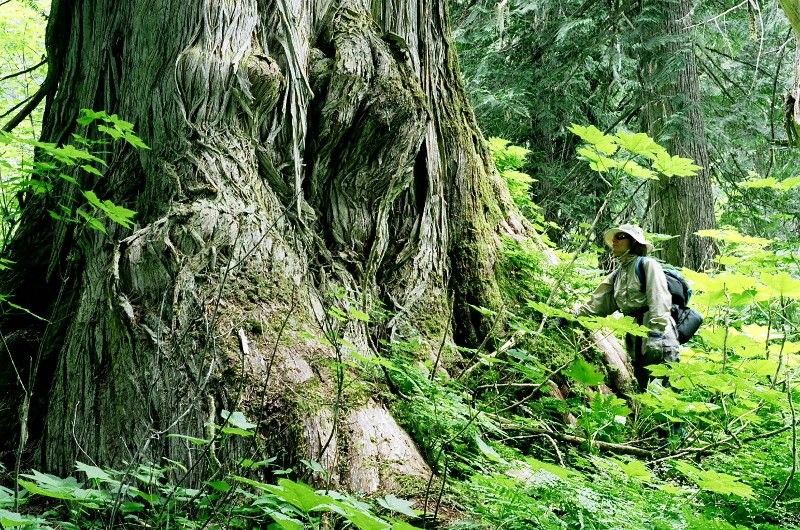

Mike Nash took an interest in what is now the Ancient Forest / Chun T’oh Whudujut Provincial Park after several years driving past its then completely unlogged and forbidding-looking forests in the late 1970s and early 1980s. It had not attracted much interest in the recreational community as it was inaccessible except by bushwhacking on foot (hiking, backcountry skiing and snowshoeing), plus the alpine tundra zone was relatively small compared to surrounding areas such as Sugarbowl-Grizzly Den, Dome Mountain, Erg Mountain, etc. However, the first time that he bushwhacked to the ridgetop, Mike realized that it had a feature unlike any of the other nearby mountain areas, namely, it had a superb vantage point of the surrounding Rocky and Cariboo Mountains and the Rocky Mountain Trench. So, for more than 40 years, from the early 1980s, he began to explore the area, alone at first, and gradually introduced others to it from the late 1980s to the early 2000s. As time went on, he also came to appreciate the magnificent lower elevation forests that we bushwhacked through to gain the ridgetop. Although he did not have a large role in the eventual trails construction or the universal boardwalk or the subsequent park proposal, Mike can trace those happenings back to two key moments: First, when he introduced UNBC’s Darwyn Coxson to the ancient cedars while leading a Naturalists Club Trip there in the early 2000s, and second when he asked Nowell Senior if he would like to do the paperwork to formalize a trail proposal. And the rest, as they say, is history.
We have included some notes on that history below. Mike also covered it in his first book, Exploring Prince George, A Guide to North Central BC Outdoors (Rocky Mountain Books, 2004 & 2007; pages 122-130) and in a Canadian Alpine Journal article and several newspaper articles for Prince George This Week, the Citizen’s former weekly.
Mike went on to map out and propose a number of spatial Old Growth Management Areas (OGMAs) for the ancient forests of Driscoll Ridge (a name that he coined, taken from the nearby Driscoll Creek), many of which were accepted and that provided effective interim protection before the park idea was developed. Darwyn went on to inspire UNBC researchers (Radies et al) to look at the area in more depth, which in turn inspired the Dome Creek residents to action in the construction of the first rustic trail, commissioning of the film “Block 486,” and their significant Forest Practices Board complaint. Two key academic conferences with field trips followed.
Nowell Senior went on to lead the development of two mountain trails (West Driscoll and East Driscoll) as well as a high elevation crossover link, and he then went on to conceive and lead the development of the universal boardwalk that became the centrepiece of the present park and the site today of your construction project. Dave King became a key player with Nowell in the building of the boardwalks. Dave, Nowell and Darwyn then went on to propose what is now the large provincial park over the area. When Mike looks back at all this today, he is staggered by what has become of an idea and from two hiking trips that sparked Darwyn and Nowell to action!
The Ancient Forest/Chun T’oh Whudujut Provincial Park, located east of Prince George, B.C., protects a globally rare inland temperate rainforest with ~2,000-year-old western redcedars. Once slated for logging, the area was saved through community activism and, in 2016, became a Class A park, celebrated for its 450-meter wheelchair-accessible boardwalk built by volunteers.


Key Historical Aspects of the Ancient Forest Trail:
- Indigenous Connection: The forest is located in the traditional territory of the Lheidli T’enneh First Nation, who historically used this area for gathering medicinal plants and as a connection to the land.
- Discovery and Protection: In the early 2000s, this area was flagged for logging. However, UNBC researcher Dave Radies and local conservationists identified the unique ecological value of the ancient trees, halting industrial development.
- The “Hiking” Movement: In 2006, the Caledonia Ramblers Hiking Society began developing trails to allow public access and showcase the forest’s beauty.
- Volunteer-Built Boardwalk: To protect the delicate, wet ecosystem, volunteers from the Caledonia Ramblers and Friends of the Ancient Forest hand-carried roughly 74 tons of materials to construct the “Nowell Senior Universal Boardwalk,” which was completed around 2013.
- Provincial Park Designation: The area was officially designated as the Ancient Forest/Chun T’oh Whudujut Provincial Park in 2016, covering roughly 11,000 hectares to protect the old-growth inland cedar-hemlock forest.
The following are some media taken over the past 20 years or so, the older ones predating any of the boardwalks:
Ancient Snow Forests of Canada (May 2011):
Driscoll Ridge Retrospective (Apr 2012):
Ancient Forests of West Driscoll Ridge (Jan 2018):
Before the developments and from the ridgetop:


