
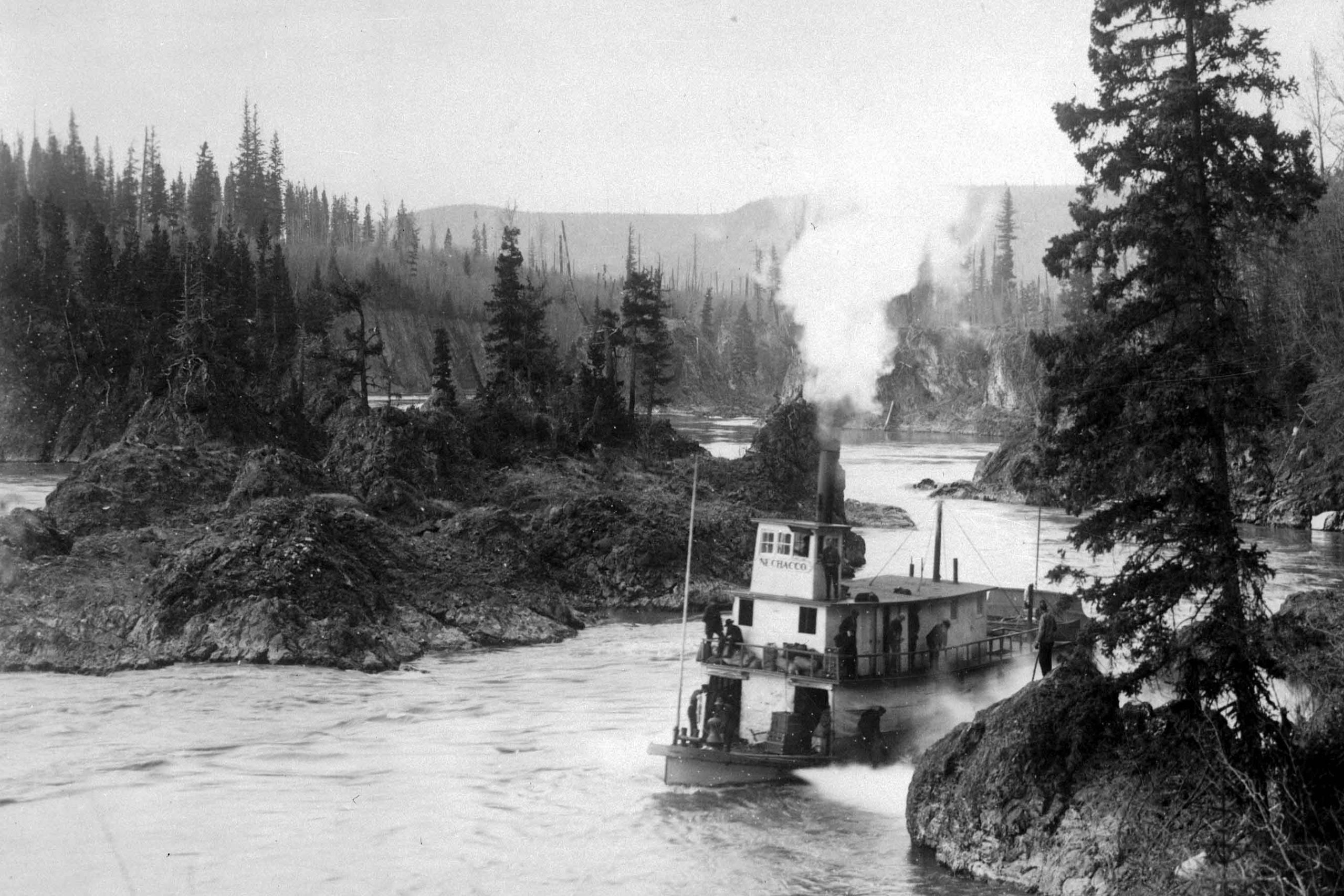

This area is a native fishing site. The canyon was a major impediment to sternwheelers, and this natural feature had a significant effect on the development of the region, particularly during railway construction. The Fraser River is designated as a Canadian Heritage River and Provincial Heritage River. As the largest river in British Columbia and the most productive salmon fishery in the world, the Fraser River has played a major role in supporting human life along its length. Locally, Fort George Canyon was an important fishing site for First Nations peoples. The river was an important route for early explorers.
In more recent years, the river was used as a route for the transportation of people and resources. Fort George Canyon was one of the few obstacles along the river in north-central British Columbia. In the early 1900’s, sternwheelers would have to be winched through this treacherous section of river, while passengers would have to portage.
By mid-June 1793, Alexander Mackenzie had reached waters flowing into the Fraser River, and on Wednesday, June 19, his group was on the main river and encountered their first major set of rapids, now known as Fort George Canyon, a few kilometers south-west of the city of Prince George.
In March of 2003, Fort George Canyon was proposed as a Provincial Park (see here).
Primary Role
The primary role of the park is to protect the Fort George Canyon, which is rated as a regionally
to provincially significant special feature.
Secondary Role
The secondary role of the park is to provide for hiking opportunities along a 4.8 km trail leading
to the west side of the Canyon. Only about 1 km of the trail is in the park.
According to the Caledonia Ramblers, Lorne and Win Glassford (the founding members of the club) are the main force behind the Trail into Fort George Canyon. Dave King adds that the route had been explored in the 1970s, and the Forest Service opened the trail in the early 1980s. The Sons of Norway Club played a role as well.
Photos:


